
Request Info Enroll Now

Architectural Engineering Technology

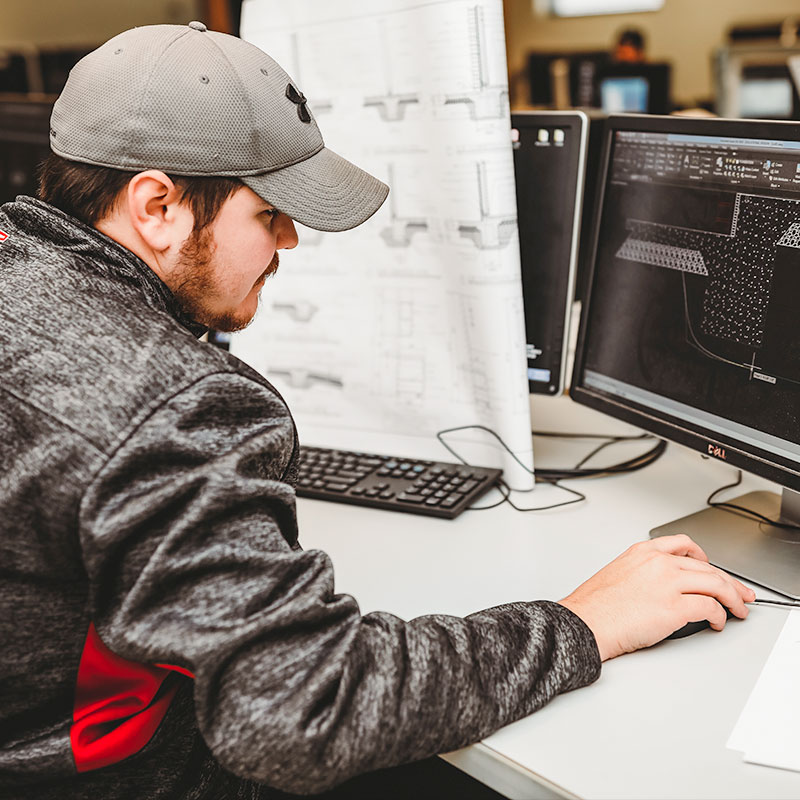
The Architectural Engineering Technology program educates students in the process of producing design projects from schematics through construction. The program is designed to prepare its graduates for employment in architectural related firms, including architectural offices, design building firms, engineering firms, governmental agencies, real estate developers, planning offices, and architectural material suppliers and manufacturers. The program offers a Technical Certificate, an Advanced Technical Certificate, and AAS Degree in Architectural Engineering Technology. Graduates may have the option of transfer leading to a Bachelor of Science Degree (BS) in Architectural Engineering Technology.


ENGINEERING TECHNOLOGY

Program Curriculum

ASSOCIATE OF APPLIED SCIENCE

FIRST YEAR:
First Semester
  • Engineering Graphics DDT 1163
    DDT 1163 – Engineering Graphics (Pre/Co-requisites: DDT 1313). This course provides an introduction to fundamentals and principles of drafting to provide the basic background needed for all other drafting courses. Two hours lecture. Two hours laboratory. Three hours credit.
  • Construction Standards and Materials DDT 1213
    DDT 1213 – Construction Standards and Materials. This course introduces the standards and materials used in the construction process. Two hours lecture. Two hours laboratory. Three hours credit.
  • Computer Aided Design I DDT 1313
    DDT 1313 – Computer Aided Design I. This course is designed to develop basic operating system and drafting skills on CAD. Two hours lecture. Two hours laboratory. Three hours credit.
  • Smart Start Pathway SSP 1002
    SSP 1002 – Smart Start Pathway. Students will enroll in the MS Works system and learn three components within the pathway: Career Awareness, Necessary Skills, and Basic Skills. They will develop the foundational skills needed for their careers, learn and practice good work habits and effective communication that is necessary in successful employment. Students will learn how to become prepared to learn new skills for future careers within their region’s workforce sector, identifying the career components that are necessary for middle-skill employment. Students will complete the WorkKeys® assessment in Workplace Documents, Applied Math, and Graphic Literacy which allows students to quantify the foundational skills needed to perform job tasks successfully and enables students to demonstrate they have these skills. Upon completion of this assessment, students will earn a National Career Readiness Certificate, a credential issued by ACT that documents work readiness.
  • Smart Start Pathway SSP 1002
    SSP 1002 – Smart Start Pathway. Students will enroll in the MS Works system and learn three components within the pathway: Career Awareness, Necessary Skills, and Basic Skills. They will develop the foundational skills needed for their careers, learn and practice good work habits and effective communication that is necessary in successful employment. Students will learn how to become prepared to learn new skills for future careers within their region’s workforce sector, identifying the career components that are necessary for middle-skill employment. Students will complete the WorkKeys® assessment in Workplace Documents, Applied Math, and Graphic Literacy which allows students to quantify the foundational skills needed to perform job tasks successfully and enables students to demonstrate they have these skills. Upon completion of this assessment, students will earn a National Career Readiness Certificate, a credential issued by ACT that documents work readiness.
Total 11 Hours
Second Semester
  • Architectural Design I DDT 1613
    DDT 1613 – Architectural Design I (Prerequisites: DDT 1313). This course is a study and development of architectural design principles for a residential and/or commercial structure utilizing a 2D or 3D application. Two hours lecture. Two hours laboratory. Three hours credit.
  • Computer Aided Design II DDT 1323
    DDT 1323 – Computer Aided Design II (Prerequisites: DDT 1163 & DDT 1313). Continuation of Computer Aided Design I (DDT 1313). Subject areas include dimensioning, sectional views, and symbols. Two hours lecture. Two hours laboratory. Three hours credit.
  • 3D Modeling DDT 2373
    DDT 2373 – 3D Modeling (Prerequisites: DDT 1323). This course will emphasize the user coordinate system and 3-D modeling. Two hours lecture. Two hours laboratory. Three hours credit.
Total 9 Hours
SECOND YEAR:
First Semester
  • Structural Detailing I DDT 2213
    DDT 2213 – Structural Detailing I (Prerequisites: DDT 1313). Structural section, terms, and conventional abbreviations and symbols used by structural fabricators and erectors are studied. Knowledge is gained in the use of the A.I.S.C. Handbook. Problems are studied that involve structural designing and drawing of beams, columns, connections, trusses, and bracing (steel, concrete, and wood). Students will utilize 2D or 3D software. Two hours lecture. Two hours laboratory. Three hours credit.
  • Cost Estimating DDT 2243
    DDT 2243 – Cost Estimating. Preparation of material and labor quantity surveys from actual working drawings and specifications. Two hours lecture. Two hours laboratory. Three hours credit.
  • Architectural Design II DDT 2623
    DDT 2623 – Architectural Design II (Prerequisites: DDT 1613). Emphasizes standard procedures and working drawings. Details involving architectural, mechanical, electrical, and structural drawings are covered, along with presentation of drawings and computer-aided design assignments. Two hours lecture. Two hours laboratory. Three hours credit.
Total 9 Hours
Second Semester
  • English Composition I ENG 1113
    ENG 1113 - English Composition I (Prerequisite: ENG 0124 or ENG 1033 with C or appropriate placement score). This course prepares the student to think critically and compose texts for academic and professional rhetorical situations. Three hours lecture. Three hours credit.
  • English Composition II ENG 1123 OR Public Speaking I SPT/COM 1113 OR Social/Behavioral Science (3)
  • College Algebra MAT 1313 OR Natural Science w/Lab (4)
  • Humanities/Fine Arts Elective (3)
  • Social/Behavioral Science Elective (3)
Total 15 Hours

(Option One) A Technical Certificate may be earned after successfully completing the first 36 hours of career technical coursework.

(Option Two) An Advanced Technical Certificate may be earned after successfully completing the first 45 hours of career technical coursework.

(Option Three) An AAS Degree may be earned after successfully completing required career technical and academic coursework.

*Approved Technical Electives: DDT 1173, 1183, 1413, 2153, 2253, 2263, 2713, 2823, 291(1-3), ENT 1154, 1183, 1323, 2133, 2243, 2253, 2263, 2343, 2353, 2363, 2643, 2713, 291(1-3), Work-Based Learning.

Enrollment in a minimum of 15 hours each semester is recommended for eligibility for state aid, institutional scholarships, and the tuition break.