
Request Info Enroll Now

Conservation Law Enforcement Technology

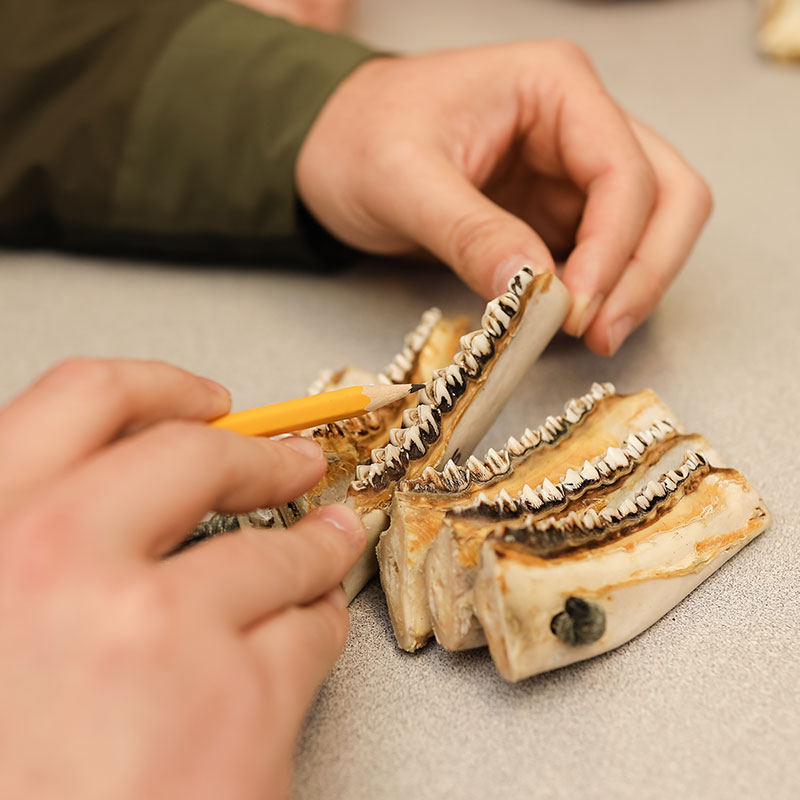
Conservation Law Enforcement Technology is a two-year program of study that prepares the graduate for entry-level employment as a Conservation Law Enforcement Officer (game warden) in the state of Mississippi. The program blends technical courses in forestry and academic courses in criminal justice with other academic courses, including the core. The Associate of Applied Science degree is earned upon successful completion of the program.


CONSERVATION LAW ENFORCEMENT TECHNOLOGY

Program Curriculum

ASSOCIATE OF APPLIED SCIENCE

FIRST YEAR:
First Semester
  • Applied Dendrology FOT 1714
    FOT 1714 - Applied Dendrology. An elementary study of trees; the habitats and principle botanical features, forms, functions, and ecological relationships. The major commercially important forest trees of the region are examined in class and through extensive field and laboratory studies. Scientific classification of plants and identification of local flora are emphasized. Two hours lecture. Four hours laboratory. Four hours credit.
  • Forest Surveying FOT 2124
    FOT 2124 - Forest Surveying. A course to provide land surveying skills required in the forest industry. Includes instruction in interpreting legal descriptions, deeds, maps, and aerial photographs, and demonstration of equipment use and surveying practices. Two hours lecture. Four hours laboratory. Four hours credit.
  • English Composition I ENG 1113
    ENG 1113 - English Composition I (Prerequisite: ENG 0124 or ENG 1033 with C or appropriate placement score). This course prepares the student to think critically and compose texts for academic and professional rhetorical situations. Three hours lecture. Three hours credit.
  • Introduction to Criminal Justice CRJ 1313
    CRJ 1313 - Introduction to Criminal Justice. History, development, and philosophy of law enforcement in a democratic society, introduction to agencies involved in the administration of criminal justice; career orientation. Three hours lecture. Three hours credit.
  • Introduction to Criminal Justice CRJ 1313
    CRJ 1313 - Introduction to Criminal Justice. History, development, and philosophy of law enforcement in a democratic society, introduction to agencies involved in the administration of criminal justice; career orientation. Three hours lecture. Three hours credit.
Total 18 Hours
Second Semester
  • Special Problem in Conservation Law FOT 2944
    FOT 2944 - Special Problem in Conservation Law. A comprehensive course dealing with management techniques and tools for wildlife populations and habitats. Eight hours laboratory. Four hours credit.
  • Silviculture I FOT 2614
    FOT 2614 - Silviculture I. A comprehensive course dealing with environmental and physiological factors and their influences on forest growth. Two hours lecture. Four hours laboratory. Four hours credit.
  • Criminology CRJ 1383
    CRJ 1383 - Criminology. The study of criminal behavior to include theories, statistics, and trends of criminal behavior. Three hours lecture. Three hours credit.
  • Social/Behavioral Science Elective (3)
  • College Algebra MAT 1313 OR Natural Science w/Lab (4)
Total 17 Hours
SECOND YEAR:
First Semester
  • Introduction to Microsoft Office BOT 1273
    BOT 1273 - Introduction to Microsoft Office. This course will introduce an operating system and word processing, spreadsheet, database management, and presentation software applications using the Microsoft® Office® suite. Two hours lecture. Two hours laboratory. Three hours credit.
  • Applications of GIS/GPS in Forestry FOT 2214
    FOT 2214 - Applications of GIS/GPS in Forestry. This course includes using remote sensing, interpretation, and application of aerial photos and other remote sensing images in forestry. This course also included the global positioning system and other remote sensing devices used in forestry. Two hours lecture. Four hours laboratory. Four hours credit.
  • Smart Start Pathway SSP 1002
    SSP 1002 – Smart Start Pathway. Students will enroll in the MS Works system and learn three components within the pathway: Career Awareness, Necessary Skills, and Basic Skills. They will develop the foundational skills needed for their careers, learn and practice good work habits and effective communication that is necessary in successful employment. Students will learn how to become prepared to learn new skills for future careers within their region’s workforce sector, identifying the career components that are necessary for middle-skill employment. Students will complete the WorkKeys® assessment in Workplace Documents, Applied Math, and Graphic Literacy which allows students to quantify the foundational skills needed to perform job tasks successfully and enables students to demonstrate they have these skills. Upon completion of this assessment, students will earn a National Career Readiness Certificate, a credential issued by ACT that documents work readiness.
  • English Composition II ENG 1123 OR Public Speaking I SPT/COM 1113 OR Social/Behavioral Science (3)
  • Internship for Specialization FOT 2923 OR Work-Based Learning WBL 1913
Total 15 Hours
Second Semester
  • Applied Soil Conservation and Use AGT 1714
    AGT 1714 - Applied Soil Conservation and Use. This course is designed to introduce the student to the general principles of soil management, as it relates to forest growth. Three hours lecture. Two hours laboratory. Four hours credit.
  • Criminal Investigation CRJ 2333
    CRJ 2333 - Criminal Investigation. A study of principles of investigation; proper collection, documentation, and preservation of evidence. Three hours lecture. Three hours credit.
  • Juvenile Justice CRJ 2513
    CRJ 2513 - Juvenile Justice. Organization, functions, and jurisdiction of juvenile agencies. Processing, detention, and disposition of cases. Statutes and court procedures applied to juveniles. Three hours lecture. Three hours credit.
  • Timber Harvesting FOT 2424 OR Forest Measurements I FOT 1114
  • Humanities/Fine Arts Elective (3)
Total 17 Hours


*For those students wishing to continue to MSU, BIO 1314 and BIO 2414 will be needed.


**MAT 1233 & a natural science with lab (7 hrs. total) OR BOT 1313 & a natural science with lab (7 hrs. total) may be substituted for College Algebra.

Enrollment in a minimum of 15 hours each semester is recommended for eligibility for state aid, institutional scholarships, and the tuition break.